

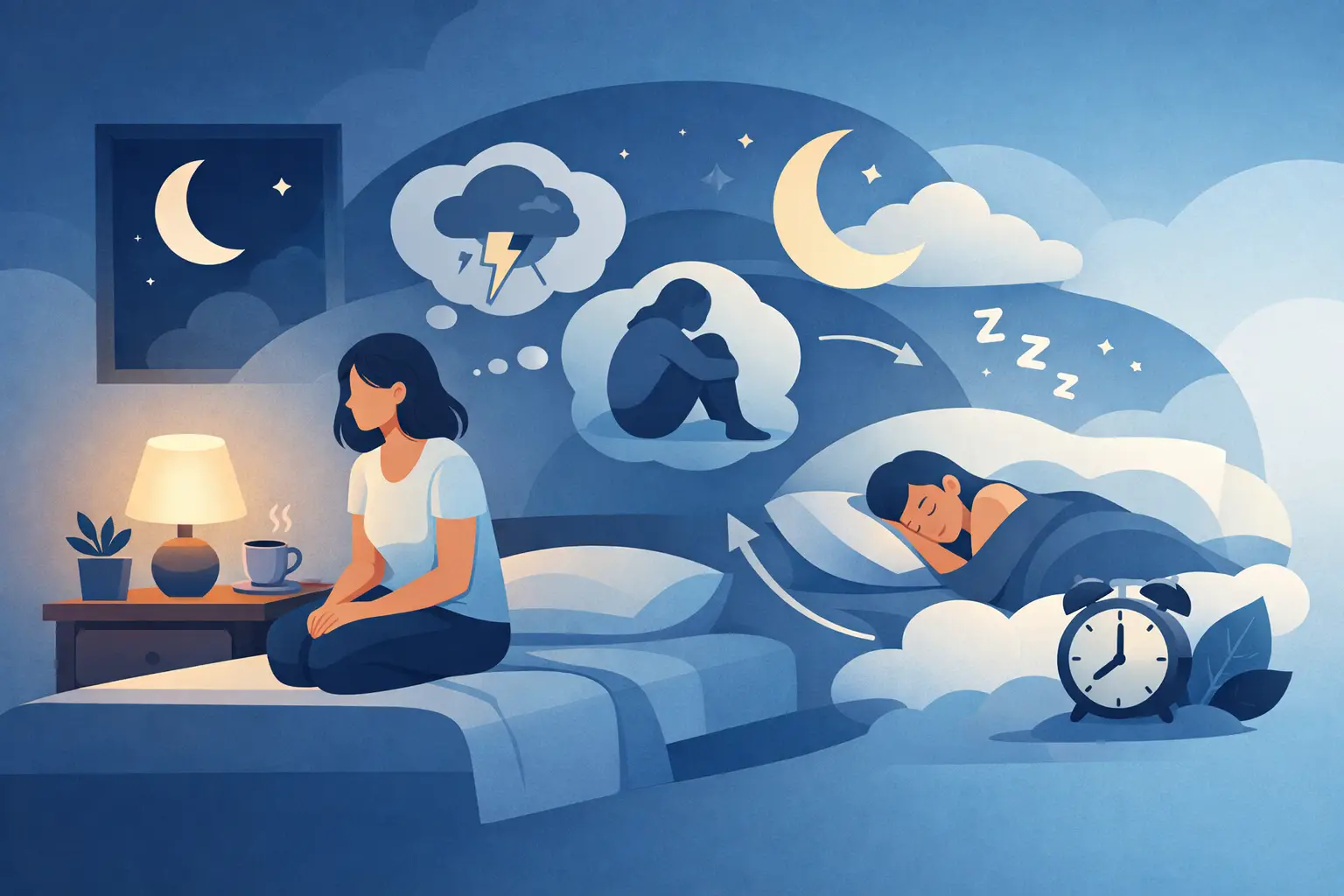
The lights are off, the day is finally quiet, and your mind suddenly begins reviewing every awkward conversation, unfinished task and possible future problem. For many adults, learning how to calm bedtime anxiety is not about forcing sleep. It is about helping a nervous system that has remained on alert all day recognise that it is safe enough to rest.
Bedtime anxiety can feel particularly frustrating because tiredness is already reducing your capacity to cope. You may notice racing thoughts, a tight chest, a restless body, a sense of dread about the next day, or worry about whether you will sleep at all. These experiences are common, but they deserve a thoughtful response rather than another night of simply pushing through.
Why anxiety can intensify at bedtime
During a busy day, work, caring responsibilities, notifications and routines can keep difficult thoughts at a distance. When stimulation drops away at night, the brain has more space to scan for unresolved concerns. For a nervous system shaped by stress, this quiet can be interpreted not as relief, but as an opportunity to problem-solve, prepare or stay vigilant.
There is also a physiological component. Anxiety activates the body’s threat response, increasing muscle tension, heart rate and mental alertness. Sleep requires the opposite state: a gradual shift towards safety, reduced stimulation and parasympathetic regulation. If you have begun to associate bed with struggling, checking the time or worrying about tomorrow, the bedroom itself can become a cue for alertness.
This does not mean you are doing sleep badly. It means your brain has learned a pattern, and learned patterns can be changed with consistent, compassionate practice.
How to calm bedtime anxiety by starting before bed
The most effective response often begins well before your head reaches the pillow. A bedtime routine is not simply a collection of relaxing activities. It is a series of repeated signals that helps your brain predict a transition from effort and vigilance to rest.
Choose a realistic wind-down period of 30 to 60 minutes. The goal is not to create a perfect evening, which can become another pressure point. Instead, reduce the inputs that keep your brain activated. Dim lights where possible, step away from work messages and avoid emotionally charged news, social media debates or complex planning late at night.
For many people, it helps to create a short ‘closing ritual’ for the day. Write down tomorrow’s essential tasks, any worry you need to revisit, and one practical next step for each concern. This gives the thinking brain evidence that it does not have to hold everything in working memory overnight.
If your thoughts are likely to become busy in bed, schedule a 10-minute worry period earlier in the evening. Sit somewhere other than the bedroom and write freely about what is troubling you. Then ask: is there an action I can take tomorrow, or is this uncertainty I need to practise carrying? This distinction is central to anxiety treatment. Some problems need a plan; others need acceptance, grounding and a willingness to stop seeking certainty.
Support your sleep drive
Sleep is influenced by more than what happens at night. Regular wake times, movement during the day, exposure to morning daylight and a balanced pattern of meals all support circadian rhythm and emotional regulation. A late-afternoon coffee, long daytime nap or several glasses of alcohol may provide short-term relief but can fragment sleep or increase early-morning anxiety.
The right approach depends on your circumstances. Some people benefit from gentle evening stretching; others find vigorous exercise too activating close to bed. If you take prescribed medication, have chronic pain, are perimenopausal, or live with ADHD, autism, trauma or depression, your sleep needs and barriers may be more complex. A personalised plan is often more useful than generic sleep advice.
Settle the body before trying to settle the mind
When anxiety is high, reasoning with every thought rarely works. The body needs cues of safety first. Start with a simple grounding practice that is easy to repeat when you are tired.
Try breathing with a slightly longer exhale than inhale. For example, breathe in gently for four counts and out for six, without forcing a deep breath. Continue for a few minutes, allowing your shoulders and jaw to soften. Longer exhalations can support the body’s calming response, while counting gives attention a neutral anchor.
Progressive muscle relaxation can also help, especially if anxiety sits in the body. Slowly tense and release one area at a time, beginning with the feet and moving upwards. Notice the difference between effort and release rather than trying to eliminate every sensation. If focusing internally makes you feel more anxious, use external grounding instead: feel the weight of the doona, notice the temperature of the room, or name five ordinary things you can see.
Mindfulness is not about clearing the mind. It is the practice of noticing what is here without immediately following it. A useful phrase is: ‘I am having the thought that I will not cope tomorrow.’ This creates a small amount of distance between you and the thought, helping you recognise it as an anxiety signal rather than a prediction.
Respond differently to the thought spiral
Bedtime anxiety often gains momentum through a familiar cycle: a worry appears, the body reacts, you check the time, then worry about the consequences of poor sleep. The struggle to guarantee sleep can become more activating than the original concern.
When you notice this cycle, respond with calm accuracy. You might say to yourself, ‘My system is activated. I do not need to solve my life at 2 am.’ Then return to your breath, a body scan or a quiet, repetitive activity. This is not avoidance. It is choosing a more appropriate time and state in which to address a problem.
Avoid repeatedly checking the clock. Time-monitoring tends to increase performance pressure and reinforces the belief that every minute awake is dangerous. If possible, turn the clock away and allow your body to rest without calculating sleep.
If you have been awake for what feels like 20 minutes or more, and frustration is building, get out of bed. Keep the lights low and do something calm and unstimulating, such as reading a familiar book or listening to gentle audio. Return to bed when you feel sleepy again. This principle, drawn from cognitive behavioural therapy for insomnia, helps rebuild the association between bed and sleep rather than bed and struggle.
Make your bedroom a lower-alert environment
Your sleep space does not need to look like a retreat to be supportive. It needs to be predictable, comfortable and as free from alerting cues as practical. A cool, dark and quiet room can help, but perfection is not required. Earplugs, an eye mask, a fan or consistent background sound may be useful if noise or light are difficult to control.
Consider whether the bedroom has become an extension of work or worry. Paying bills in bed, scrolling through messages or discussing stressful logistics under the covers can train the brain to remain switched on. Where possible, keep problem-solving and screens outside the sleep space.
For neurodivergent adults, sensory needs matter. The feel of bedding, ambient noise, temperature and the pressure of a weighted blanket may influence regulation significantly. A weighted blanket can feel calming for some people, but it is not suitable for everyone, particularly where mobility, breathing or certain health concerns are present. Comfort is individual, and your body’s feedback is the guide.
When bedtime anxiety needs professional support
Self-guided strategies can be powerful, but persistent sleep anxiety is not something you must manage alone. Consider speaking with a GP or mental health professional if anxiety is affecting sleep most nights, interfering with work or relationships, causing panic symptoms, or leading you to rely on alcohol, medication or avoidance to get through the evening.
Therapy can help identify the drivers beneath the night-time pattern. Cognitive behavioural therapy can address worry habits and unhelpful beliefs about sleep. Acceptance and Commitment Therapy can build skills for making room for difficult internal experiences without becoming controlled by them. A neuro-informed, person-centred approach can also explore stress load, trauma responses, sensory processing, ADHD, mood, relationships and lifestyle factors that shape nervous system regulation.
Keystone Therapy supports clients to understand these patterns in context, not as personal failings. Meaningful change often comes from combining practical sleep strategies with deeper work on anxiety, emotional regulation and the conditions your brain needs to feel safe.
If bedtime brings distress that feels unbearable, or you are having thoughts of harming yourself, seek urgent support through your GP, local emergency services or a crisis service. You deserve immediate care, especially when the night feels isolating.
Tonight, choose one small action rather than trying to overhaul your sleep. Write down tomorrow’s tasks, breathe out a little longer, or leave the bed before frustration takes over. Repeated gently, these signals teach your nervous system that night can become a place for rest again.