

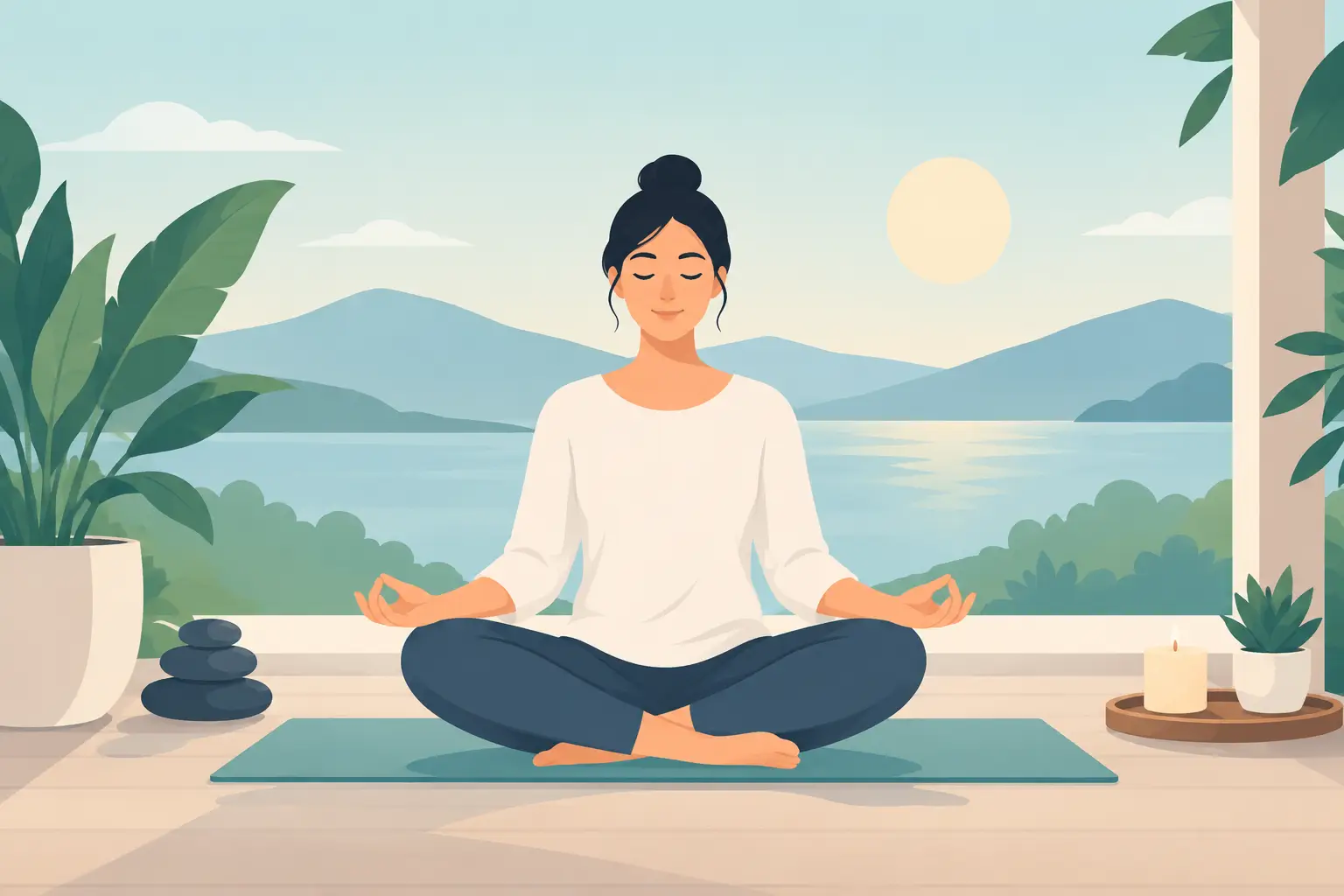
Stress often arrives before we have language for it. It may show up as a tight chest before a meeting, an irritable response to a small request, racing thoughts at 2 am, or the sense that your mind never quite powers down. The best mindfulness practices for stress are not about forcing yourself to feel calm. They are structured ways to notice what your nervous system is doing, create a little more space around the experience, and choose your next response with greater awareness.
From a brain-based perspective, stress is not simply a thought problem. It involves the ongoing interaction between the brain, body, sleep, relationships, workload, health and past experiences. Mindfulness can support regulation within this system, particularly when it is practised consistently and adapted to your needs rather than treated as another task to perform perfectly.
Why mindfulness can reduce stress
When the brain detects threat, the body shifts towards protection. Attention narrows, muscles prepare for action, breathing may become shallow, and the mind scans for what could go wrong. This response is useful when there is immediate danger. The difficulty arises when work pressure, uncertainty, conflict, financial strain or unprocessed emotional experiences keep the threat system switched on for long periods.
Mindfulness trains attention to return to present-moment experience with curiosity rather than judgement. This does not make difficult circumstances disappear. It can, however, reduce the secondary layer of stress created by fighting internal experiences, catastrophising, or becoming swept away by every thought and sensation.
Research-informed approaches such as Acceptance and Commitment Therapy (ACT) use mindfulness in this way. The aim is not to eliminate anxiety or stress on command. It is to develop psychological flexibility: the capacity to make room for discomfort while acting in ways that reflect your values and priorities.
Best mindfulness practices for stress: start with the body
For many people, beginning with the body is more accessible than trying to empty the mind. Stress is embodied, so practices that involve breathing, movement and sensory awareness can give the nervous system clear information that the present moment may be safer than it feels.
1. Lengthen the exhale
Try breathing in gently through the nose, then allowing the out-breath to last slightly longer than the in-breath. For example, breathe in for three or four counts and out for five or six, without straining. Continue for one to three minutes.
A longer exhale can support the parasympathetic branch of the autonomic nervous system, which is associated with rest, digestion and recovery. The key is softness. Deep, forceful breathing can make some people light-headed or more aware of anxiety. If that happens, return to your natural breath and simply notice the air moving at the nostrils or chest.
2. Use a brief sensory grounding practice
Grounding is especially useful when your thoughts are looping or you feel disconnected from your surroundings. Pause and identify a few neutral details: the pressure of your feet inside your shoes, the temperature of a mug in your hands, sounds in the room, or the texture of fabric against your skin.
This is not distraction in the dismissive sense. It is an attentional shift that helps the brain update its understanding of where you are now. If your stress is linked to a difficult memory, sensory grounding may be gentler and more stabilising than closing your eyes for a longer meditation.
3. Try a three-minute body check-in
Several times across the day, ask: what sensations are present right now? You may notice a clenched jaw, raised shoulders, fatigue behind the eyes, heat in the face or a hollow feeling in the stomach. Name the sensation without immediately trying to solve it.
Then ask what would be supportive in the next ten minutes. The answer may be water, food, a stretch, a boundary, a short walk, a slower pace or a conversation. This practice builds interoception, which is the ability to recognise internal bodily signals. Stronger interoceptive awareness can make it easier to respond to stress before it becomes overwhelming.
4. Walk with your attention, not your phone
A mindful walk does not need to look like a formal exercise session. On the way to the car, around the block, or during a lunch break, bring attention to the rhythm of your steps, the movement of your arms and the visual detail around you. Notice colour, light, sounds and the contact between your feet and the ground.
Walking can be particularly helpful for people with ADHD, restless energy or difficulty sitting still. Movement gives attention an anchor while also supporting the natural discharge of stress activation. If you can, leave your mobile in your pocket for five minutes. The goal is not to be perfectly present, but to practise returning when your mind wanders.
Working differently with stressful thoughts
Mindfulness is sometimes misunderstood as positive thinking. It is not. It asks for an honest relationship with what is happening, including thoughts that are uncomfortable, repetitive or self-critical.
Name the mental event
When a stressful thought appears, experiment with adding the words, “I am noticing the thought that…” before it. Instead of “I will fail at this”, try “I am noticing the thought that I will fail at this.” The content may still feel convincing, but the phrasing creates a small amount of distance.
This technique, often called cognitive defusion in ACT, helps reduce the tendency to treat every thought as a fact, instruction or prediction. It is not about arguing with your mind. It is about recognising that the mind generates stories, especially when it is trying to protect you from uncertainty.
Make room for the feeling beneath it
Stress frequently sits alongside other emotions: grief, disappointment, fear, anger, shame or loneliness. If you have a moment of privacy, place a hand on your chest or abdomen and name what is here as simply as possible: “This is anxiety”, “This is pressure”, or “This is a hard moment.”
For some people, self-compassionate language can help: “It makes sense that this feels difficult.” This is not indulgence or resignation. A compassionate stance reduces the internal conflict that can intensify stress and makes practical problem-solving more possible.
Build mindfulness into ordinary routines
A 20-minute meditation may be valuable, but it is not the only meaningful form of practice. For people balancing work, caring responsibilities, neurodivergent needs, low mood or poor sleep, smaller practices are often more sustainable. Repetition matters more than intensity.
Choose one existing routine as your cue. You might take three slower breaths before opening your laptop, notice the first few bites of lunch without scrolling, pause at the front door before entering home, or spend one minute noticing body sensations before bed. These small moments teach the brain that attention can be redirected, even on demanding days.
It also helps to connect mindfulness with lifestyle foundations. A stressed brain is more reactive when sleep is disrupted, meals are irregular, movement is absent, alcohol is being used to manage distress, or there is little time for restorative connection. Mindfulness is not a substitute for these factors. It works best as part of a broader approach to wellbeing that considers the whole person.
When mindfulness needs to be adapted
Mindfulness is generally flexible, but it is not identical for everyone. Quiet, eyes-closed meditation can increase distress for some people, particularly those with trauma histories, panic symptoms, dissociation or intense intrusive thoughts. Others may find that focusing on breath makes them more anxious.
In these situations, keep your eyes open, orient to the room, use movement or external sensory cues, and practise for very short periods. A trauma-informed therapist can help you identify approaches that support safety and regulation rather than pushing you beyond your window of tolerance.
If stress is persistent, affecting sleep, relationships or work, or occurring alongside depression, panic, thoughts of self-harm, substance use or trauma symptoms, mindfulness alone may not be enough. Structured therapeutic support can help clarify the patterns maintaining distress and develop a plan that integrates psychological strategies, nervous system regulation and practical changes. At Keystone Therapy, this integrative lens can help clients understand stress not as a personal failure, but as information that deserves skilled attention.
The most useful practice is usually the one you can return to on an ordinary Tuesday, not only when life is quiet. Begin with one minute, one breath or one sensory detail. Each return is a small act of attention that can help your nervous system learn that there is more than one way to meet pressure.