

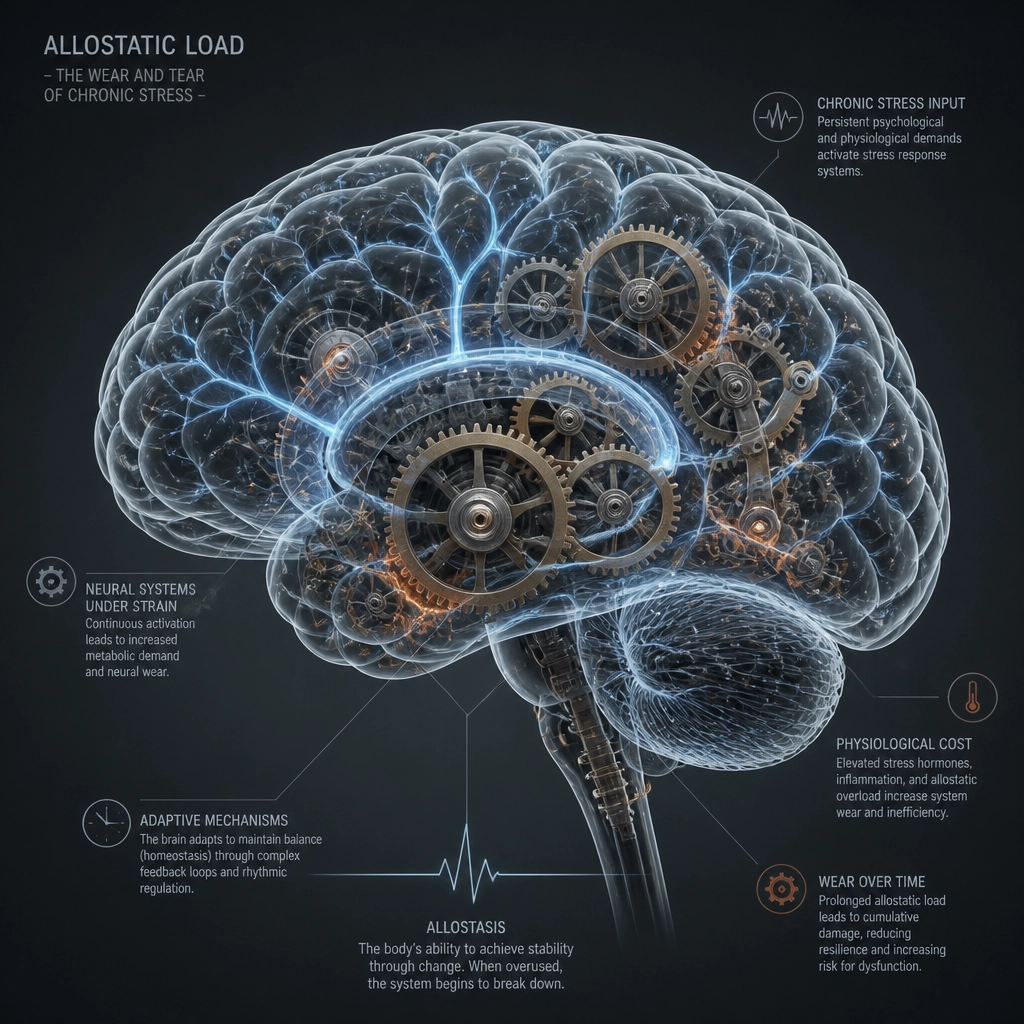
This article unpacks the clinical concept of allostatic load: the cumulative physiological "wear and tear" that results from chronic stress exposure. You will learn how the brain, acting as the body’s central command, eventually begins to "wear out" when the demands of the environment consistently exceed the organism's capacity to adapt. This guide explains the latest 2026 research linking allostatic load to cardiovascular disease, cognitive impairment, and premature mortality, while introducing the ARCHR²™ framework as a methodology for diagnostic assessment and neurological re-tuning.
The Bio-Mechanics of Chronic Stress: Homeostasis vs. Allostasis
In the field of lifestyle mental health, we often distinguish between two biological states: homeostasis and allostasis.
- Homeostasis: The body’s ability to maintain a stable internal environment (like temperature or blood pH) within a very narrow range.
- Allostasis: The process of achieving stability through change. This is the brain’s proactive, predictive system that adjusts physiological parameters: such as heart rate, cortisol levels, and immune activation: to meet anticipated environmental demands.
While allostasis is a brilliant evolutionary adaptation, it comes with a metabolic price. When the "stress" never truly ends: due to social dislocation, professional burnout, or environmental mismatch: the brain remains in a high-arousal state. This persistent activation is what we call allostatic load.
At Keystone Therapy, we view this through the lens of a "Brain Mechanic." Just as a high-performance engine can only run at redline for so long before the gaskets leak and the oil degrades, the human brain and nervous system have a finite threshold for sustained high-pressure operation.
The 2026 Research Landscape: Why Allostatic Load Is a Diagnostic Signal
For decades, allostatic load was considered an abstract academic concept. However, landmark longitudinal studies published in early 2026 have shifted the perspective, positioning it as a critical diagnostic signal for long-term health outcomes. High allostatic load is no longer just a "feeling of stress"; it is a measurable precursor to systemic breakdown.
1. Cardiovascular Disease (CVD)
Recent 2026 data from the UK Biobank prospective cohort demonstrates a graded, non-linear increase in incident cardiovascular events as allostatic load scores rise. Individuals with a high load score (≥6) were found to have a hazard ratio of 2.15 for incident CVD. This suggests that chronic stress-driven inflammation: specifically neutrophil-centric inflammation: is a primary driver of heart disease, independent of traditional risk factors like high cholesterol alone.
2. Premature Mortality
Meta-analyses of 17 major studies now show that high allostatic load is associated with a 22% to 46% higher risk of all-cause mortality. The 2026 Chinese population-based cohort indicated that for every 1-point increase in an individual’s allostatic load score over a four-year period, the risk of premature death increased by 21%.
3. Cognitive Impairment and "Brain Wear"
The link between allostatic load and cognitive decline has become increasingly clear. Persistent cortisol dysregulation and neuroinflammation (inflammation of the brain’s immune cells) lead to a reduction in hippocampal volume: the area responsible for memory: and a thinning of the prefrontal cortex, which governs executive function and emotional regulation. This is the biological reality of "burning out": the hardware of the brain is physically changing in response to the load.

Allostatic Load as an Ecological Mismatch
At Keystone Therapy, we utilize the mismatch thesis. This suggests that many symptoms: anxiety, depression, sleep disorders, and brain fog: are not arbitrary malfunctions. Instead, they are adaptive responses to an environment the human brain was never designed to inhabit.
When your environment requires you to be "always on," socially isolated, and sedentary, your brain’s predictive model assumes you are in a high-threat survival situation. The symptoms you experience are the "warning lights" on your dashboard, signaling that your allostatic load has reached a critical level.
The ARCHR²™ Framework: Re-tuning the System
Traditional "talk therapy" often focuses on the content of your thoughts. However, if your brain is wearing out due to allostatic load, you cannot simply "think" your way into a lower heart rate or reduced neuroinflammation. You need a system-wide tune-up.
The ARCHR²™ framework (Assessment, Regulation, Connection, Healing, Reinforcement, Resilience) is our proprietary clinical approach designed to address the physiological foundations of mental health.
| Stage | Clinical Focus | Objective |
|---|---|---|
| Awareness | Ecological Formulation | Identifying the environmental "load" and internal signals. |
| Regulation | Mind-Body Integration | Utilizing neuroacoustic therapy and breathwork to lower autonomic arousal. |
| Connection | Co-regulation | Using the therapeutic relationship to provide evidence of safety to the brain. |
| Healing | Memory Reconsolidation | Processing accumulated trauma through somatic and neuro-counselling techniques. |
| Reinforcement | Habit Formation | Embedding new neurological patterns through lifestyle medicine and repetition. |
| Resilience² | Adaptive Capacity | Generating a new baseline that can withstand future environmental challenges. |

Practical Interventions for Reducing Load
While professional intervention is often necessary for high allostatic load, the following subsections outline immediate, evidence-based strategies to begin reducing the "wear and tear" on your system:
1. Prioritise Vagal Tone
The vagus nerve is the "brake" of your nervous system. Techniques such as psychoneuroimmunology-informed cold exposure, rhythmic breathing, or neuroacoustic protocols (like the ARCH™ Sound Protocol) can help re-establish ventral vagal dominance, signaling to the brain that the threat has passed.
2. Environmental Redesign
If the environment is the diagnosis, then the environment must be the cure. This involves "social thickening": increasing meaningful, face-to-face human connection: and reducing digital overstimulation, which acts as a constant, low-level stressor.
3. Sleep Architecture
Sleep is the brain’s primary maintenance cycle. During deep sleep, the glymphatic system "washes" the brain of metabolic waste. High allostatic load disrupts this process, creating a vicious cycle of cognitive impairment. Restoring sleep rhythm is a non-negotiable step in the Brain Mechanic's toolkit.

Safety Considerations and Professional Guidance
It is important to note that while lifestyle adjustments are beneficial, a high allostatic load can often mask or exacerbate underlying clinical conditions. If you are experiencing persistent heart palpitations, severe cognitive "fog," or chronic physical exhaustion, it is vital to seek a comprehensive assessment.
The ARCHR²™ framework emphasizes that Regulation must come before Connection. You cannot effectively process emotional trauma or change your life habits if your nervous system is in a state of high-arousal "emergency."
Conclusion: Take the Brain Mechanic Assessment
Your brain is a remarkably resilient organ, but it is not indestructible. Allostatic load reveals that the "grind" culture we often celebrate is biologically unsustainable. When you understand that your symptoms are signals of cumulative wear and tear, you can stop blaming your "willpower" and start addressing your biology.
At Keystone Therapy, we don't just talk about problems; we look at the machinery. If you feel like your "engine" is overheating, it may be time for a professional diagnostic.
Are you ready to measure and manage your load?
Book a Brain Mechanic Assessment today and discover how the ARCHR²™ framework can help you re-tune your nervous system for long-term health and resilience.